

Gratitude can make you generous, attentive, and willing to show up for the people who matter to you. But when gratitude quietly turns into the belief that you must always be available, every request can begin to feel like an obligation. A shift needs covering. Someone needs a favor. A committee has an empty seat. A friend asks for help.
Before you have even checked your calendar, energy, or priorities, the answer comes out: yes.
Then the cost arrives later. Your schedule tightens. Your patience runs low. You stay up later trying to make one more commitment fit into a week that was already full. In those moments, it is worth remembering that gratitude for your relationships does not require unlimited access to your time.
The harder moment often comes when you finally say no. Even when the request is unreasonable, even when you genuinely do not have room, a quick wave of guilt can make you feel as if you have done something wrong.
That feeling is real. Yet it is not necessarily reliable. Guilt after a boundary can be an alarm, not a verdict. Once you understand that difference, you can practice gratitude for others without abandoning yourself.
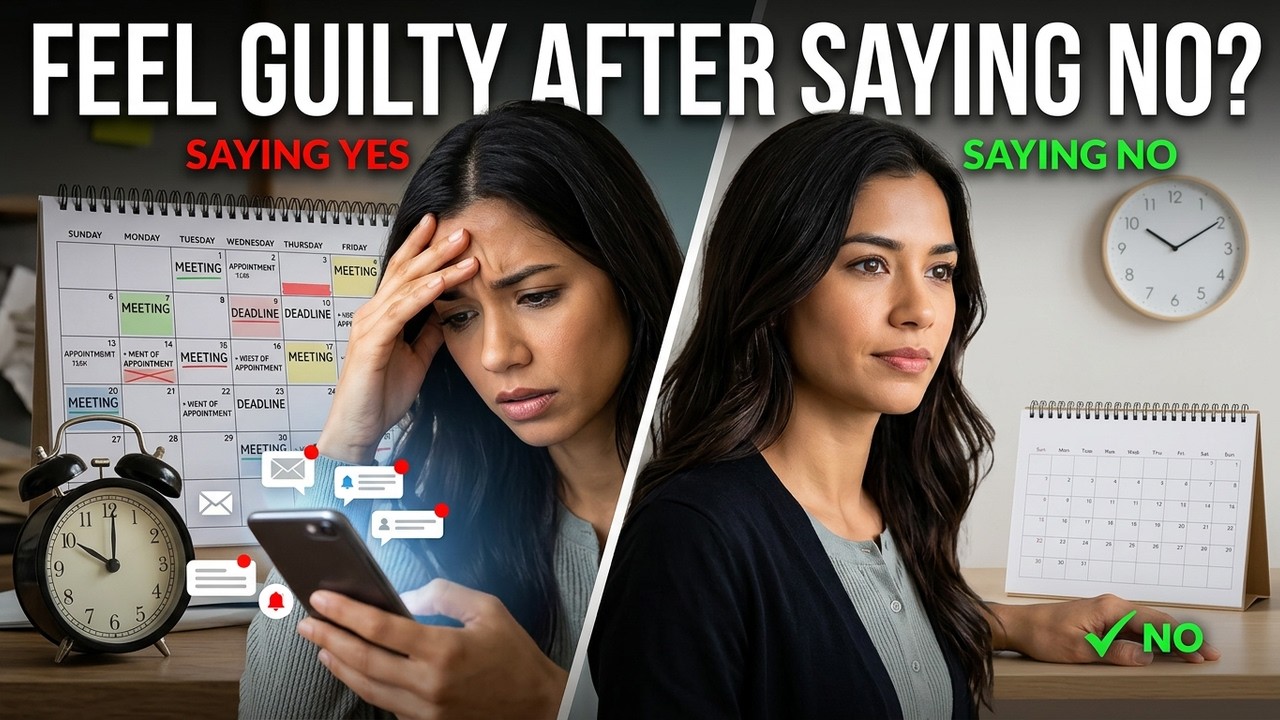
The Reflexive Yes and Its Hidden Cost
A reflexive yes is usually not a sign that you have plenty to give. More often, it is a fast response designed to avoid discomfort. You may say yes before considering whether the task fits, whether you have the energy, or what will need to be displaced to make it happen.
That immediate agreement can feel easier than pausing. It may protect you from the discomfort of disappointing someone in the moment. But the discomfort does not disappear. It simply moves into the future, where it can show up as stress, resentment, exhaustion, or a shorter temper with the people closest to you.
Gratitude does not mean treating your own limits as unimportant. You can appreciate being trusted, invited, or asked while still recognizing that the answer needs to be no.
A request is not automatically a responsibility. Someone else’s need may be real, but that does not mean you are the right person to meet it at this particular time.
Why Saying No Can Feel So Guilty
It would seem logical for a well-chosen no to bring relief. You protect your time, avoid overcommitting, and remain honest about what you can do. Instead, many people experience an immediate guilty flush, as though they have been caught being unkind.
This is particularly common for people who already help a great deal. If you are regularly dependable, accommodating, and responsive to other people’s needs, a boundary can feel out of character. But one no does not erase your generosity. It simply acknowledges reality.
Many adults identify with struggling to say no or with people-pleasing tendencies. That makes this experience common ground, not evidence of a personal defect. Your discomfort does not mean you are selfish. It may mean you have spent a long time associating being good with being endlessly accommodating.
Healthy gratitude can support kindness. Guilt-driven agreement, however, can make kindness feel compulsory. There is a meaningful difference between offering help because you want to and agreeing because you are afraid of how a refusal might be judged.
Guilt May Be Following an Old Rule
The guilt that rises after a no is often responding to more than the request directly in front of you. It may be tied to an older internal rule: other people’s comfort is your job to manage.
When that rule is active, the word “no” can trigger an alarm immediately. The alarm does not pause to assess whether the person asking is upset, whether the request was fair, or whether your refusal was necessary. It simply reacts to the possibility that someone may be disappointed.
This is why guilt can feel so persuasive. It arrives fast and speaks with urgency. But urgency is not the same as accuracy.
You do not need to argue with the feeling or pretend it is absent. Instead, you can recognize it with more precision: “I am feeling guilt because I said no. That does not prove the no was wrong.”
That small distinction creates room for both boundaries and gratitude. You can care about how your choices affect others without making every uncomfortable feeling an instruction to reverse your decision.
What Guilt Is Not Telling You
- It is not proof that you have harmed someone.
- It is not proof that the other person is angry.
- It is not proof that you must explain yourself in detail.
- It is not proof that your schedule, energy, and needs do not matter.
- It is not a requirement to offer a larger favor later as compensation.
Gratitude works best when it is freely given. When it is shaped by fear, it can become a reason to say yes past the point where you have anything left to give.
The Part Other People Cannot See
When someone asks for help, they are usually focused on the immediate need. They see the shift that needs coverage, the event that needs support, or the task that needs someone to take it on. They may not see every other responsibility already sitting in your week.
They do not automatically know about the calendar you are managing, the energy you have already spent, or the commitments that are invisible from the outside. Your full plate is still full, even when someone else cannot see it.
Research on requests suggests that people asking for help can overestimate how reluctant others will be to help and underestimate the cost of turning them down. This means both people can enter the interaction with distorted expectations. You may be bracing for a painful reaction, while the person asking may not realize how difficult it was for you to keep saying yes.
This perspective can make room for compassion on both sides. You do not need to assume the other person is demanding or uncaring. At the same time, you do not need to act as if they have complete knowledge of your capacity.
A clear no is sometimes the most honest information you can provide. It gives the other person a chance to make another plan, and it gives you a chance to honor the limits that make your existing commitments sustainable.
Your Imagined Reaction Is Often Bigger Than the Real One
Before you decline, your mind may create a vivid prediction. Perhaps the other person will feel wounded. Perhaps the relationship will become strained. Perhaps they will think you are unreliable, selfish, or difficult.
Yet real responses are often much smaller than the ones you imagine. A no may receive a simple “okay,” “no worries,” or a brief acknowledgment before the other person moves on to finding another solution.
Studies involving real refusals of invitations and requests have found a consistent pattern: people who decline tend to predict stronger negative reactions than the people receiving the refusal actually report. The imagined damage is often larger than the real damage.
This does not mean every person will be pleased with every boundary. Some people may feel disappointed, and disappointment is a normal human response. But another person’s disappointment is not necessarily evidence that you have acted badly.
Gratitude can help you hold this moment with maturity. You can appreciate the relationship, respect the other person’s feelings, and still allow them to manage their own response. You are responsible for communicating honestly and civilly. You are not responsible for removing every trace of discomfort from another person’s life.
For a broader overview of boundary-setting as a relationship skill, the American Psychological Association’s resources on stress and healthy workplaces offer useful context on protecting well-being amid competing demands.
The Problem Is Not Feeling Guilty
Guilt is not the enemy. Feeling uneasy when you disappoint someone can reflect that you are attentive to other people. It can show that connection, consideration, and gratitude matter to you.
The real problem begins when you treat guilt as a command.
That command may sound like this:
- “I should take the no back.”
- “I need to explain more so they do not think badly of me.”
- “I should apologize again.”
- “I should offer to do something even bigger later.”
- “I need to check immediately to see whether they replied.”
These reactions try to get rid of the uncomfortable feeling as quickly as possible. Unfortunately, they can teach you that guilt must always be obeyed. Over time, that pattern makes saying no feel even harder.
A more helpful approach is to let the feeling exist without giving it control. You can call it what it is: a familiar alarm. An alarm can be loud without signaling an actual emergency.
You can feel guilty and still keep your boundary. That is not coldness. It is emotional steadiness.
A Simple Gratitude Practice for Saying No This Week
The most useful practice is not hypothetical. Choose one real request that is already in front of you, one that you do not have room to accept.
Then respond in one short, plain sentence. Do not build a lengthy case for why your answer is justified. Do not search for an excuse larger than the truth requires.
You might say:
“I can’t take that on this week, but thank you for thinking of me.”
This response carries both clarity and gratitude. It acknowledges the request without pretending you can meet it. It is polite without becoming an opening for negotiation. It is enough.
Follow These Four Steps
- Identify the real request. Choose something you genuinely cannot fit into your current week.
- Give a direct answer. State that you cannot take it on, using a short and respectful sentence.
- Do not soften it repeatedly. Avoid multiple apologies, detailed defenses, or immediate substitute offers.
- Wait one hour before reacting to guilt. Do not check for a reply, send another message, or revise the boundary during that hour.
If there is a real logistical issue to address after the hour has passed, you can handle it on its own terms. But do not let the first surge of guilt decide what happens next.
This is where gratitude becomes grounding rather than draining. You can be thankful for being included, thankful for the relationship, and thankful for the opportunity to be honest. You do not have to repay every request with access to your time.
What Happens When You Leave the Guilt Alone
After you say no, you may return to ordinary life: your desk, the kitchen sink, a school pickup line, or the next task waiting for you. At first, the guilt may still feel close. Then, without extra apologies or reassurance-seeking, it often begins to fade into the background.
Nothing may need to be repaired. No follow-up message may be necessary. The request that did not fit will still not fit, and that can simply be true.
Your week may feel lighter, not because you forced guilt to disappear, but because you did not feed it. You allowed the sensation to pass rather than using it as a reason to overextend yourself again.
This is a hopeful skill because it is learnable. Each honest no gives you evidence that discomfort can be survived. Each boundary helps you distinguish genuine gratitude from self-erasure. Each time you honor your capacity, you make it more possible to offer meaningful help when you truly can.
Choose One Honest No
Today, notice the next request that arrives. Pause before answering. Check whether there is actually room for it. If there is not, choose a clear response and allow gratitude to remain present without turning it into obligation.
You can be kind. You can be civil. You can care deeply about people. And you can still say, “I can’t take that on this week.”
The guilt may sound its alarm. You do not have to let it make the decision.